
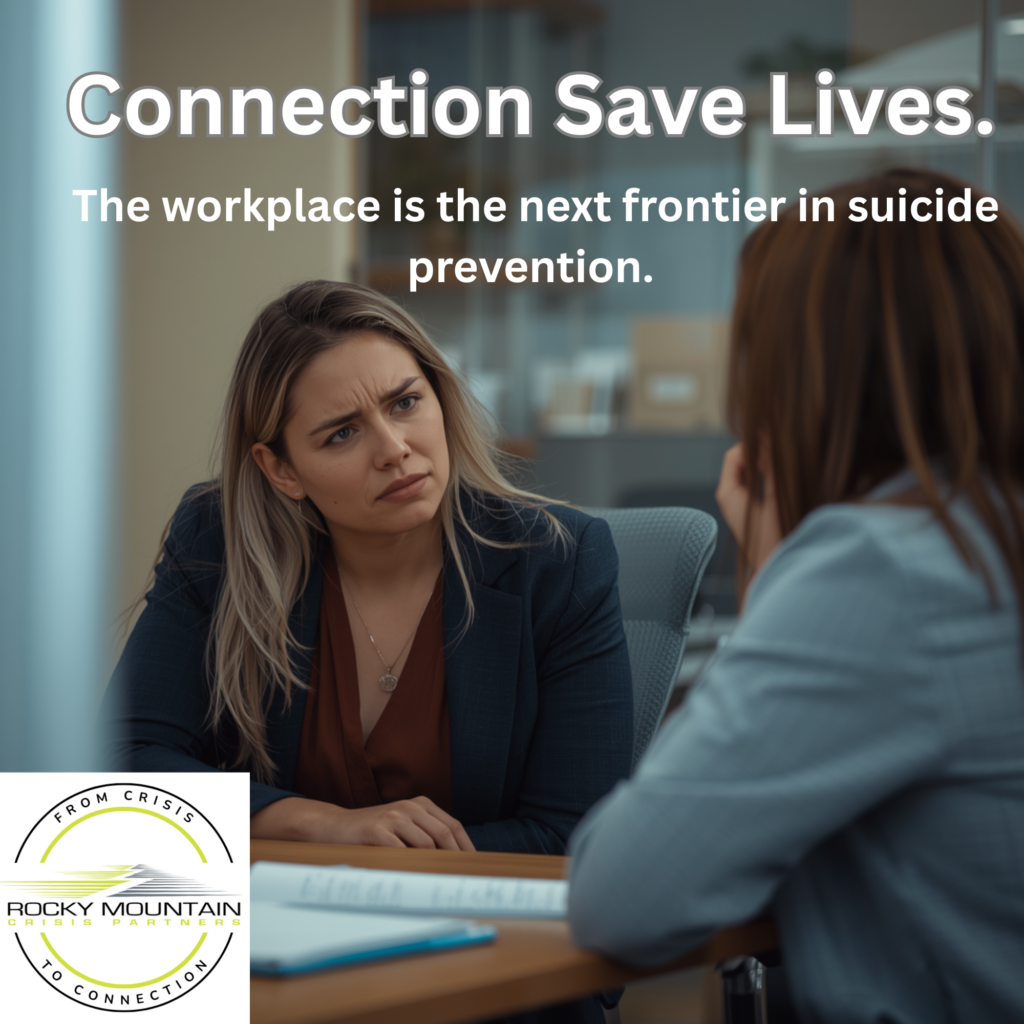
Why Suicide Prevention Needs Workplaces (and Vice Versa)
We have a “billboard” problem in suicide prevention.
Across the country, public-facing awareness campaigns flash across our screens and line our highways. They are well-intentioned, often beautifully designed, and vital for keeping the conversation alive. But they suffer from a fundamental flaw: the “Not Me” filter. When a message is broadcast to everyone, it is too easy for the individual in the midst of a quiet, crushing struggle to believe it is for someone else—someone “sicker,” someone “different,” someone else.
If we want to move the needle on suicide prevention, we have to go where people actually are. We have to go to work.
The Captive Audience and the Power of Proximity
The majority of adults spend more than half of their waking lives at work. This makes the workplace the single most consistent touchpoint for adult human connection in our society. We all have heard (or felt) the realities of work, where we may see our coworkers way more than our own families. While a doctor might see a patient once a year, a colleague or manager sees them daily. They see the subtle shift in tone, the receding hairline of engagement, and the quiet withdrawal that public awareness campaigns simply cannot reach.
Workplaces don’t just host employees; they house a captive audience. This proximity offers a unique opportunity to bypass the “Not Me” mentality. When suicide prevention is integrated into the culture of a team, it stops being a generic public health message and starts being a local, meaningful, communal pact.
The Keepers of Stability
We must be honest about the factors that contribute to despair. Suicide is rarely about a single “mental health” diagnosis; it is often the result of a compounding sense of instability. Workplaces hold the “keys” to the most significant protective factors in an adult’s life:
Schedule: Controls when and where we show up
Financial Security: The ability to provide for oneself and one’s family.
Social Belonging: A sense of being part of a collective mission.
Purpose: The knowledge that one’s contribution matters.
When a workplace becomes “enlightened” to these factors, it stops being a mere source of stress and starts becoming a scaffold for a “life worth living.” By prioritizing fair wages, predictable schedules, and a sense of agency, an employer is performing suicide prevention before a crisis even begins.
The Cultural Laboratory: From the Office to the World
Perhaps the most unrecognized power of the workplace is its ability to set the “moral thermostat” for wider society. The behaviors we model at the office don’t stay at the office; they are carried home in briefcases, lunchboxes, cars…and even through our screens for our virtual workplaces.
When a workplace normalizes help-seeking—when it eliminates punitive responses to personal struggle and replaces them with structured support—it is doing more than just saving an employee. It is training that employee on how to be a more empathetic parent, a more observant neighbor, and a more supportive friend.
By modeling that “struggle is human and help is available,” a company creates a ripple effect. If you change the culture within a corporation of 500 people, you are effectively influencing 500 households, neighborhoods, and networks. The impact is exponential.
Moving Beyond Awareness to Action
The next era of suicide prevention isn’t about more slogans; it’s about tangible next steps. It is about the manager who is trained to have a difficult conversation without fear. It is about the HR policy that treats a mental health leave with the same dignity as a maternity leave. It is about a culture where “checking in” is as standardized as a safety briefing.
Workplaces have the power to turn “awareness” into “action.” They have the infrastructure to direct specific resources to the people who need them most, leaving no room for the “not me” mentality. It is time for employers to realize they aren’t just managing a workforce; they are stewarding human lives. And in that stewardship lies the power to change—and save—the world.
The Architecture of Hope
The suicide prevention field has spent decades working tirelessly to erode the walls of stigma and build bridges to help-seeking. They have provided the tools, the research, and the crisis lines. But they cannot be in the breakroom, the Zoom call, or the job site. They cannot be the ones to look a struggling colleague in the eye and say, “I see you, and your seat at this table is safe.”
That power belongs to the workplace.
As a leader, a manager, or a colleague, you are the architect of the environment where most adults spend their lives. You have a choice: you can maintain a culture where struggle is hidden for fear of consequence, or you can model a new standard of humanity.
When you normalize the conversation around mental health, when you replace judgment with genuine support, and when you protect the dignity of those who are hurting, you aren’t just “managing” a team—you are disrupting the cycle of despair. You are teaching your people that their worth is not tied to their output, and that seeking help is a sign of strength, not a career-ending vulnerability.
The “awareness” on the billboards can only go so far. Real, life-saving cultural change happens in the hallways and the boardrooms. It happens when we decide that no one should have to choose between their livelihood and their life.
It is time for the workplace to embrace its most profound role: not just as a place of business, but as a sanctuary of stability. You hold the keys. You set the tone. And in doing so, you have the power to create a world where every life is truly felt to be a life worth living.